
Published · By SNR Foods
What Is Tomato Puree and How Is It Made? A Complete Guide for Food Manufacturers
Tomato puree is a smooth, concentrated tomato product made from ripe tomatoes after pulping and removing most seeds and skins. Learn how tomato puree is made, how it differs from tomato paste, key quality parameters, packaging options, and what food manufacturers should consider when buying tomato puree in bulk.
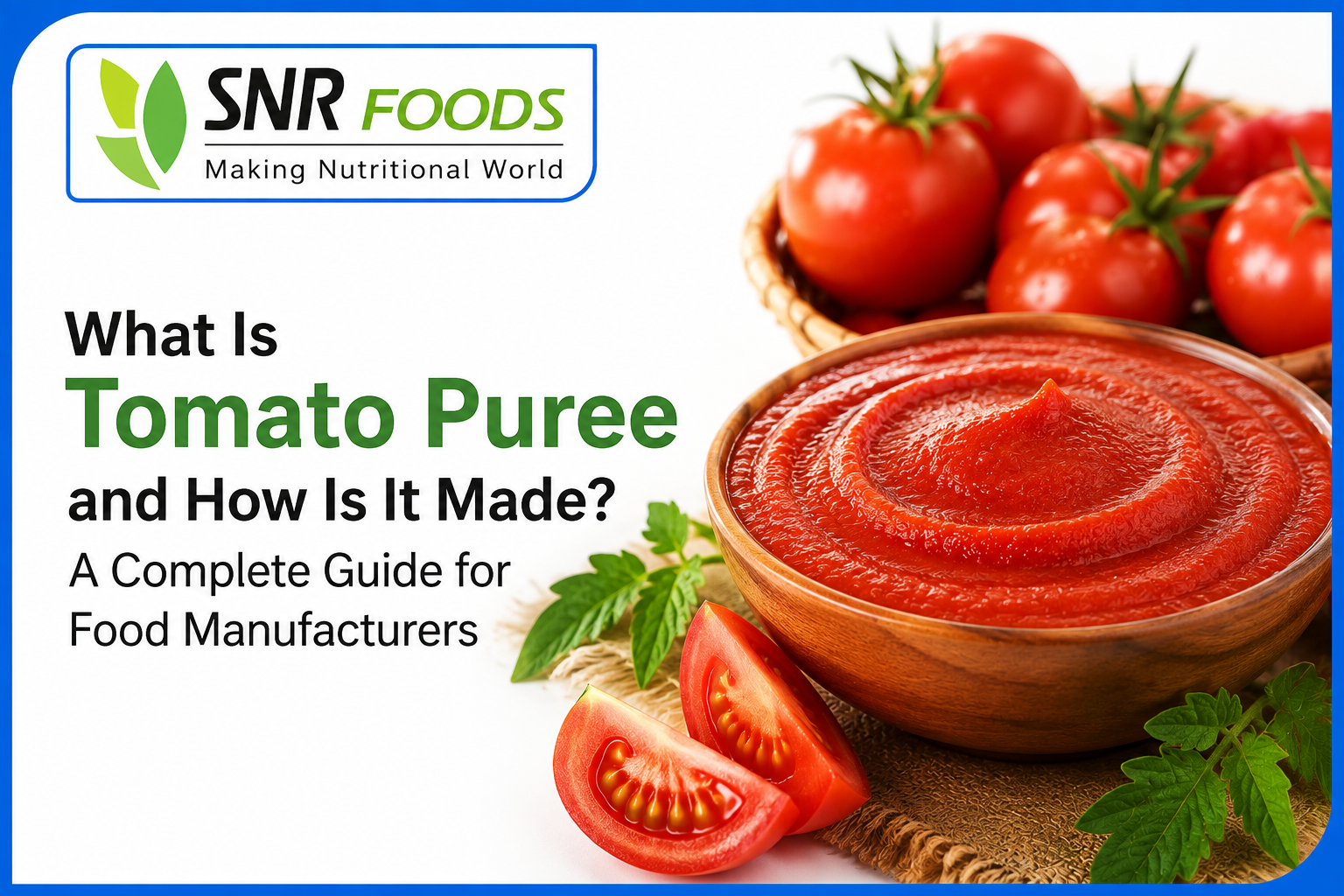
Tomato puree is a smooth, processed tomato product made from mature, red tomatoes. The tomatoes are cleaned, sorted, processed into pulp, and strained to remove most skins, seeds, and coarse material. The resulting tomato concentrate can be used as an ingredient in sauces, soups, ready-to-eat foods, beverages, frozen foods, pizza products, and other food applications.
For food manufacturers and bulk buyers, understanding how tomato puree is made is important because processing, soluble solids, colour, consistency, packaging, and storage conditions can directly affect the performance of the finished product.
What Is Tomato Puree?
Tomato puree is a processed tomato concentrate produced from sound, mature red tomatoes. The tomatoes are processed into juice or pulp and strained to remove most of the skins, seeds, and coarse or hard materials.
According to the Codex Standard for Processed Tomato Concentrates, tomato concentrate can be designated as tomato puree when it contains at least 7% but less than 24% natural total soluble solids. Tomato paste, by comparison, contains at least 24% natural total soluble solids.
This distinction is particularly relevant for B2B buyers because the required concentration depends on the application, formulation, processing requirements, and desired flavour and consistency.
How Is Tomato Puree Made?
Commercial tomato puree manufacturing involves several controlled processing stages. While exact processes can vary between manufacturers and product specifications, the general production process includes the following steps:
- Tomato sourcing: Mature, red tomatoes suitable for processing are selected as the raw material.
- Sorting and inspection: Tomatoes are inspected and unsuitable or damaged material is removed.
- Washing: The tomatoes are thoroughly washed to remove soil, field debris, and other unwanted material.
- Crushing: The tomatoes are mechanically broken down to release the tomato pulp and juice.
- Heat treatment: Depending on the manufacturing process, controlled heating may be used to influence enzyme activity and the consistency of the resulting puree.
- Pulping and refining: The crushed tomatoes pass through pulping or finishing equipment that separates much of the skin, seeds, and coarse material from the tomato pulp.
- Concentration: If required by the product specification, water is removed from the tomato pulp to achieve the desired soluble-solids concentration.
- Quality testing: The finished puree can be evaluated for parameters such as Brix, colour, consistency, flavour, odour, texture, and microbiological quality.
- Packaging: The finished tomato puree is packed using a suitable food-grade packaging system designed to protect the product during storage and transportation.
Processing conditions matter because tomato consistency can change during concentration. Research on industrial tomato processing has shown that consistency and serum viscosity can change during concentration and storage.
What Is the Difference Between Tomato Puree and Tomato Paste?
The primary difference between tomato puree and tomato paste is their concentration of natural soluble tomato solids.
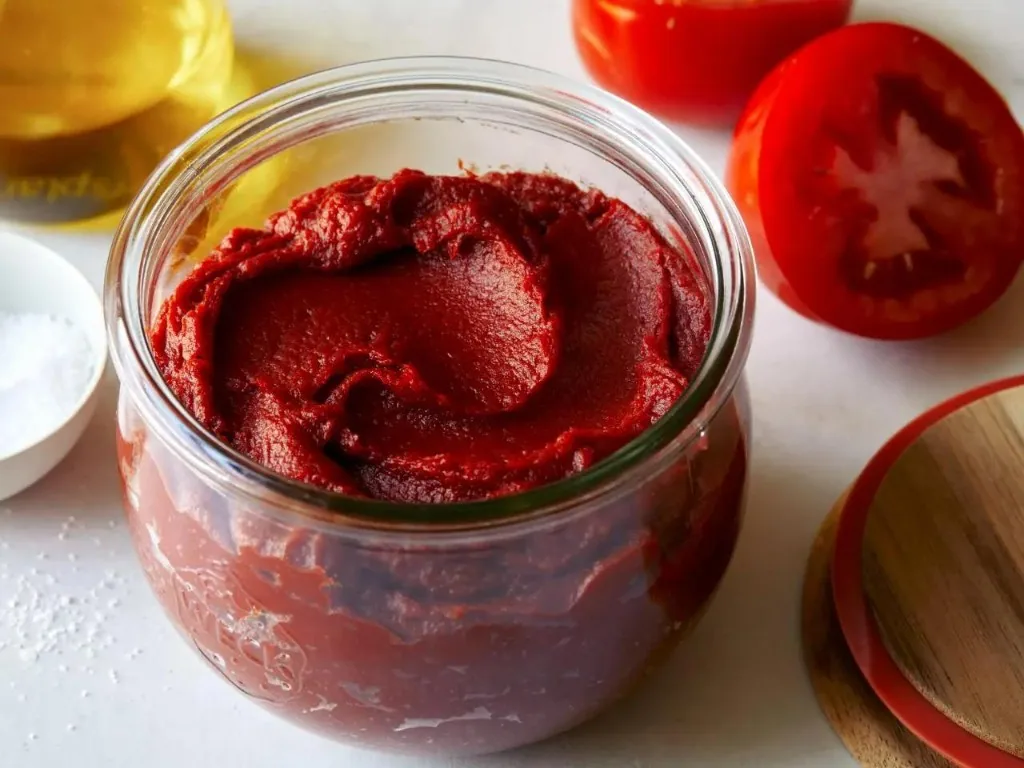
Natural soluble tomato solids At least 7% and below 24% At least 24% Consistency Generally less concentrated More concentrated and thicker Typical use Sauces, soups, prepared foods and formulations Sauces, ketchup, pizza products and food manufacturing Processing requirement Lower concentration than paste Higher concentrationThe right choice depends on the formulation. Manufacturers should select the product based on the required Brix, texture, colour, flavour profile, application, and processing conditions rather than choosing purely based on price.
What Are the Key Quality Parameters of Tomato Puree?
When buying tomato puree in bulk, buyers should evaluate more than just the product's appearance. Several technical and commercial parameters can influence the final application.
1. Brix
Brix indicates the concentration of soluble solids in the product. It is an important specification when manufacturers need consistency across multiple production batches.
The required Brix should be agreed between the buyer and supplier according to the intended application and formulation.
2. Colour
Tomato colour can influence the visual appearance of sauces, soups, prepared foods, and other finished products. A consistent red colour is therefore an important consideration for commercial food production.
3. Consistency and Texture
The texture of tomato puree can affect how easily it blends with other ingredients and how the finished product behaves during processing.
4. Flavour and Aroma
Good-quality tomato puree should have the characteristic flavour and odour expected of the product without undesirable off-notes.
5. Microbiological Quality
Food manufacturers should work with suppliers that follow appropriate food-safety and good manufacturing practices and can provide relevant product specifications and quality documentation.
6. Packaging
Packaging is especially important when tomato puree is purchased in bulk. The packaging format should be appropriate for the product, storage conditions, transportation requirements, and intended production process.
7. Shelf Life
A defined shelf life helps manufacturers plan inventory, production schedules, and international shipments more effectively.
What Packaging Is Used for Bulk Tomato Puree?
Commercial tomato puree can be supplied in food-grade bulk packaging designed for industrial handling, transportation, and storage.
For large-volume food manufacturers, bulk packaging can offer operational advantages by reducing frequent handling and making the product easier to integrate into industrial production systems.
The packaging format should always be selected according to the product specification, intended shelf life, storage conditions, logistics requirements, and destination market.
What Is Aseptic Tomato Puree?
Aseptic tomato puree is tomato puree processed and packed using an aseptic packaging system designed to protect the commercially processed product from contamination during filling and storage.
Aseptic packaging is particularly relevant for B2B food manufacturers because it can support long-distance transportation and extended storage without requiring the same handling approach as refrigerated fresh tomato products.
However, buyers should always verify the supplier's actual shelf-life, packaging specifications, storage conditions, and technical documentation before placing a bulk order.
Where Is Tomato Puree Used?
Tomato puree is a versatile ingredient used across food manufacturing. Common applications include:
- Tomato sauces
- Pizza sauces
- Ketchup and condiment formulations
- Ready-to-eat meals
- Soups
- Gravies and cooking sauces
- Frozen foods
- Snack and prepared-food applications
- Foodservice products
- Other processed-food formulations
The ideal tomato puree specification depends on the final product. A sauce manufacturer may have different requirements from a ready-meal manufacturer or foodservice supplier.
Why Is Tomato Puree Used Instead of Fresh Tomatoes?
For industrial food production, tomato puree can provide greater formulation consistency and operational convenience than processing fresh tomatoes in-house.
Instead of washing, sorting, crushing, pulping, and processing fresh tomatoes for every production cycle, manufacturers can use a standardized tomato ingredient with an agreed specification.
This can help manufacturers simplify production, improve batch-to-batch consistency, reduce raw-material handling, and plan procurement more efficiently.
How Should Food Manufacturers Buy Tomato Puree in Bulk?
Bulk buyers should evaluate both the product and the supplier before committing to a large order.
Important considerations include:
- Required Brix or soluble-solids specification
- Colour and appearance
- Consistency and texture
- Flavour and aroma
- Packaging format
- Shelf life
- Food-safety and quality documentation
- Production capacity
- Minimum order quantity
- Export and logistics capability
- Supplier reliability and consistency between batches
For a more detailed purchasing checklist, read: Things to Check Before Buying Tomato Paste in Bulk .
Buy Tomato Puree and Tomato Paste in Bulk from SNR Foods
SNR Foods Pvt Ltd supplies tomato-based ingredients for food manufacturers, foodservice businesses, and other B2B applications.
If you are looking for a reliable supplier for bulk tomato puree or tomato paste, product specifications should be discussed based on your application, required Brix, packaging requirements, order volume, destination, and storage conditions.
Buy Tomato Paste from SNR Foods
Looking for a bulk tomato ingredient supplier for your next production run? Place your order now or contact SNR Foods to discuss your requirements.
Frequently Asked Questions About Tomato Puree
What is tomato puree made from?
Tomato puree is made primarily from mature red tomatoes. The tomatoes are processed into pulp or juice and strained to remove most skins, seeds, and coarse material. Depending on the specification, the product may then be concentrated to achieve the required soluble-solids level.
Is tomato puree the same as tomato paste?
No. Tomato puree and tomato paste differ primarily in concentration. Under the Codex Standard for Processed Tomato Concentrates, tomato puree contains at least 7% but less than 24% natural total soluble solids, while tomato paste contains at least 24%.
What does Brix mean in tomato puree?
Brix is a measure of soluble solids and is commonly used as an important specification for processed tomato products. The required Brix depends on the product and its intended application.
How long does tomato puree last?
Shelf life depends on the formulation, processing method, packaging, storage conditions, and supplier specification. Bulk buyers should always confirm the manufacturer's stated shelf life and storage requirements before purchasing.
What is aseptic tomato puree?
Aseptic tomato puree is processed tomato puree filled into packaging under controlled aseptic conditions. Aseptic packaging is commonly used for commercially processed food ingredients that need protection during storage and transportation.
Where can I buy tomato puree in bulk in India?
Food manufacturers can source tomato puree from industrial food ingredient suppliers such as SNR Foods Pvt Ltd. Buyers should compare product specifications, Brix, colour, consistency, packaging, shelf life, documentation, production capacity, and supplier reliability before placing a bulk order.
What should I check before buying tomato puree in bulk?
Check Brix, colour, consistency, flavour, packaging, shelf life, microbiological specifications, documentation, minimum order quantity, production capacity, logistics capability, and supplier reliability.
Final Takeaway
Tomato puree is more than simply processed tomatoes. For food manufacturers, the value of a commercial tomato puree lies in the consistency of its specifications and its ability to perform reliably in the final formulation.
Understanding the production process, Brix, colour, consistency, packaging, shelf life, and supplier capabilities can help buyers make better bulk procurement decisions.
If you are sourcing tomato puree or tomato paste for commercial production, speak with SNR Foods about your specific requirements.
Inquire Now → Discuss Your Bulk Tomato Requirement with SNR Foods
Our products
Other Fruits
Aseptic red papaya, white guava, pineapple and banana puree and concentrate, plus seasonal raw fruits sourced directly from our partner farmers.
Read moreGet in touch
Have a question about this post or our products? Send us a message and our team will get back to you.