
Published · By SNR Foods
Bubbles in Tomato Puree or Concentrate: What Food Manufacturers Should Know
Bubbles in tomato puree or concentrate can indicate several quality or handling issues. Learn what causes bubbling, when it may be a concern, and what B2B buyers should check before using bulk tomato ingredients.
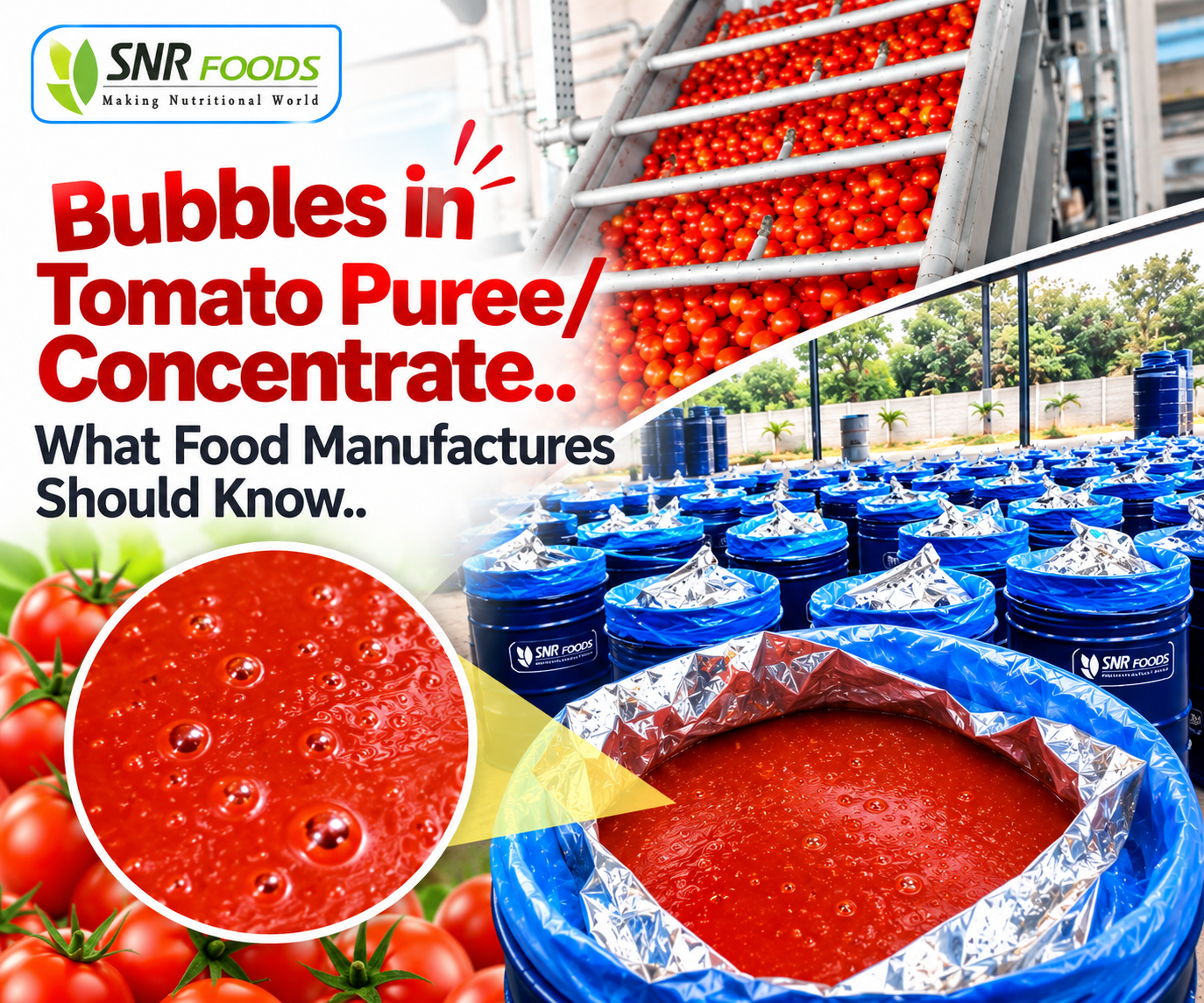
Tomato puree and concentrate are widely used as essential ingredients across the food processing industry. From sauces and ketchup to ready-to-eat meals, soups, seasonings, and other processed foods, manufacturers depend on consistent tomato ingredients for flavor, color, texture, and production efficiency.
However, food manufacturers and bulk buyers may sometimes notice bubbles, pressure, gas formation, or changes in the appearance of tomato puree or concentrate. The first question is usually: “Is this normal?”
The answer depends on the type of packaging, processing method, storage conditions, and the condition of the product. In some situations, bubbles can simply result from air introduced during handling. In other situations, persistent bubbling, gas formation, unusual odors, or package swelling may indicate a quality or microbiological issue that needs attention.
Understanding the possible causes can help manufacturers make better purchasing, storage, and quality-control decisions when sourcing tomato puree and concentrate in bulk.
Why Can Bubbles Appear in Tomato Puree or Concentrate?
Bubbles can appear in tomato-based ingredients for several reasons. Not every bubble automatically indicates that the product is spoiled, but unusual or persistent bubbling should not be ignored.
Some common causes include:
- Air incorporated during processing, filling, or handling
- Agitation during transportation or movement of the product
- Changes in temperature during storage or transportation
- Fermentation or microbial activity
- Packaging or sealing problems
- Improper storage conditions
For industrial food manufacturers, it is important to distinguish between temporary air bubbles caused by handling and gas formation associated with product deterioration.
When Are Bubbles a Quality Concern?
A small amount of trapped air can sometimes be introduced into a tomato puree or concentrate during filling, pumping, transportation, or handling. These bubbles may disappear after the product settles and do not necessarily indicate a product-quality problem.
However, manufacturers should pay closer attention when bubbling is accompanied by other changes in the product or packaging.
- Unusual or strong odor
- Unexpected changes in color
- Abnormal texture
- Continuous gas formation
- Swollen or pressurized packaging
- Leakage from the package
- Unexpected changes in acidity or pH
If several of these signs are present, the product should be isolated and evaluated according to the manufacturer's food-safety and quality-control procedures.
Why Packaging Matters for Tomato Puree and Concentrate
Packaging plays an important role in maintaining the quality and stability of processed tomato ingredients. Bulk tomato products need packaging that protects the product from contamination, oxygen exposure, leakage, and other external factors during storage and transportation.
Aseptic packaging is commonly used for industrial fruit and vegetable preparations because it provides a controlled packaging environment and helps protect the product throughout its intended shelf life.
For B2B buyers, packaging specifications should therefore be considered alongside product specifications such as Brix, pH, acidity, microbiological parameters, and shelf life.
Tomato Puree vs Tomato Concentrate
Although tomato puree and tomato concentrate are both processed tomato ingredients, they have different characteristics and applications.
Tomato puree generally retains a higher proportion of the tomato's natural water content and provides a smooth tomato base for food formulations.
Tomato concentrate is produced by removing a portion of the water from processed tomatoes, resulting in a product with a higher concentration of soluble solids. It can be particularly useful for manufacturers looking for a concentrated tomato ingredient for sauces, ketchup, ready-to-eat foods, and other applications.
The appropriate ingredient depends on the manufacturer's formulation, processing method, required Brix, viscosity, flavor profile, and final application.
Applications of Tomato Puree and Concentrate
Tomato ingredients are used across a wide range of food manufacturing applications. Their versatility makes them an important raw material for both large-scale manufacturers and foodservice businesses.
- Ketchup & Sauces – Tomato ketchup, pasta sauces, pizza sauces, and cooking sauces
- Ready-to-Eat Foods – Gravies, curries, meal bases, and prepared foods
- Soups – Tomato soups and other tomato-based formulations
- Seasonings & Food Products – Tomato-based seasonings, fillings, and processed food products
- Foodservice – Commercial kitchens, restaurants, caterers, and institutional food operations
The choice between puree and concentrate depends on the required formulation and the manufacturing process.
What Should Bulk Buyers Check Before Purchasing?
When purchasing tomato puree or concentrate in bulk, buyers should look beyond price and consider the complete product specification.
- Brix: The soluble solids level required for the intended application
- pH and acidity: Important parameters for formulation and quality control
- Microbiological specifications: Essential for food safety and product consistency
- Packaging: Packaging format, material, filling method, and suitability for transportation
- Shelf life: Expected stability under recommended storage conditions
- Color and texture: Important for finished-product appearance and consistency
- Traceability: Batch information and documentation for quality management
Clear specifications can help manufacturers maintain consistency across production batches and reduce unexpected formulation or quality issues.
How Storage and Transportation Can Affect Tomato Ingredients
Even a properly processed tomato product needs to be handled according to its recommended storage and transportation conditions.
Exposure to unsuitable temperatures, physical damage to packaging, improper handling, or compromised packaging can affect product quality.
For bulk buyers, it is therefore important to inspect packaging upon receipt and maintain appropriate storage conditions throughout the supply chain.
Any unusual changes in packaging condition, appearance, odor, or product behavior should be documented and reported to the supplier's quality team for evaluation.
Why Quality Control Matters for Food Manufacturers
For food manufacturers, the quality of a raw ingredient directly affects the consistency of the finished product. Variations in Brix, acidity, color, texture, microbiological quality, or flavor can influence the final formulation and production process.
This is why reliable sourcing is particularly important when purchasing tomato puree or concentrate in bulk.
A dependable supplier should be able to provide appropriate product specifications, batch information, quality documentation, packaging details, and support for the buyer's application requirements.
Why Choose SNR Foods?
At SNR Foods, we focus on supplying processed fruit and vegetable ingredients for food and beverage manufacturers looking for dependable bulk sourcing solutions.
Our tomato puree and tomato concentrate can be used across a variety of industrial food applications, including sauces, ketchup, ready-to-eat foods, soups, and other processed food products.
We understand that B2B buyers need more than just a product. Consistent specifications, appropriate packaging, reliable supply, and quality-focused processing are all important when selecting an ingredient supplier.
Final Thoughts
Bubbles in tomato puree or concentrate should not automatically be considered a sign of spoilage, as air can sometimes be introduced during processing, filling, transportation, or handling. However, persistent bubbling, gas formation, unusual odor, package swelling, or other unexpected changes should be investigated rather than ignored.
For food manufacturers purchasing tomato ingredients in bulk, choosing the right product specifications, packaging, storage conditions, and supplier can make a significant difference to production consistency and food quality.
If you are looking for tomato puree or concentrate for your manufacturing requirements, connect with SNR Foods to discuss your product specifications, volumes, packaging, and sourcing needs.
Inquire now to discuss bulk tomato puree and concentrate requirements with SNR Foods.
Our products
Other Fruits
Aseptic red papaya, white guava, pineapple and banana puree and concentrate, plus seasonal raw fruits sourced directly from our partner farmers.
Read moreGet in touch
Have a question about this post or our products? Send us a message and our team will get back to you.